
Quantitative survival.
Nys and colleagues evaluated E. coli, S. agalactiae, and C. albicans in ESwab® and the Venturi system.
Open the Nys publication →Research RounduP
Estimated read time: 7 minutes
In clinical diagnostics, the quality of a result often starts at specimen collection. Even the best molecular assay or culture protocol cannot compensate for an inadequate specimen. That is why swab design, an early, seemingly simple step in the pre-analytical phase, has a significant impact on pathogen recovery and, ultimately, the clinical sensitivity of the diagnostic assay.
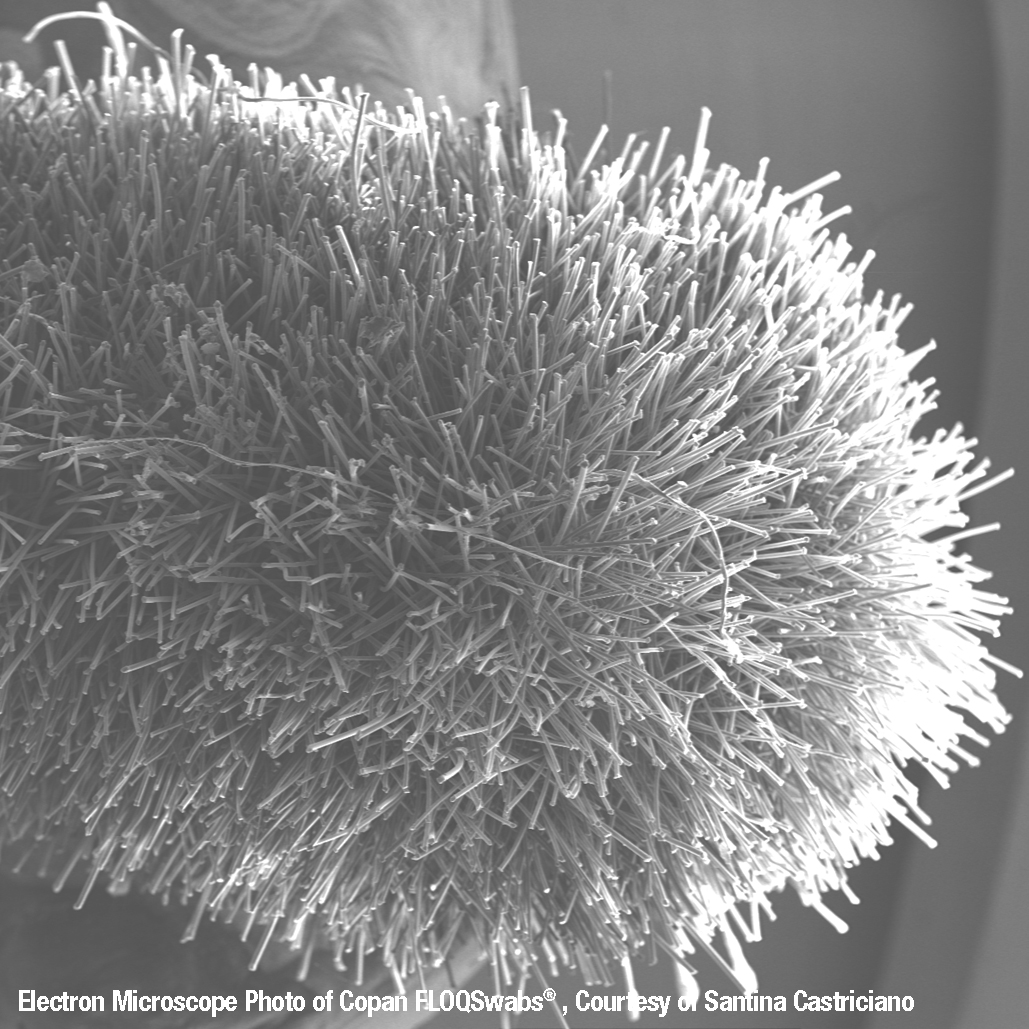
Using thousands of perpendicular microfibers to efficiently pick up cells and microbes, FLOQSwabs® then release them into liquid media with minimal retention. Across a growing body of peer-reviewed studies, this flocked design has proven to consistently deliver higher cellular yield, better organism recovery, and clearer microscopy compared with traditional wound fiber swabs, such as rayon.1-8
Traditional rayon and cotton swabs have an absorbent core that can trap specimen material, leading to only a limited fraction being released into transport medium or assay reagents. Flocked swabs are designed as brush-like, open-fiber devices and do not contain an internal core, promoting rapid uptake and near-complete elution of the specimen into liquid.
This difference is not just theoretical. Multiple studies measuring cell counts and detection rates demonstrate meaningful performance gains with flocked designs in clinical workflows.1,7-8
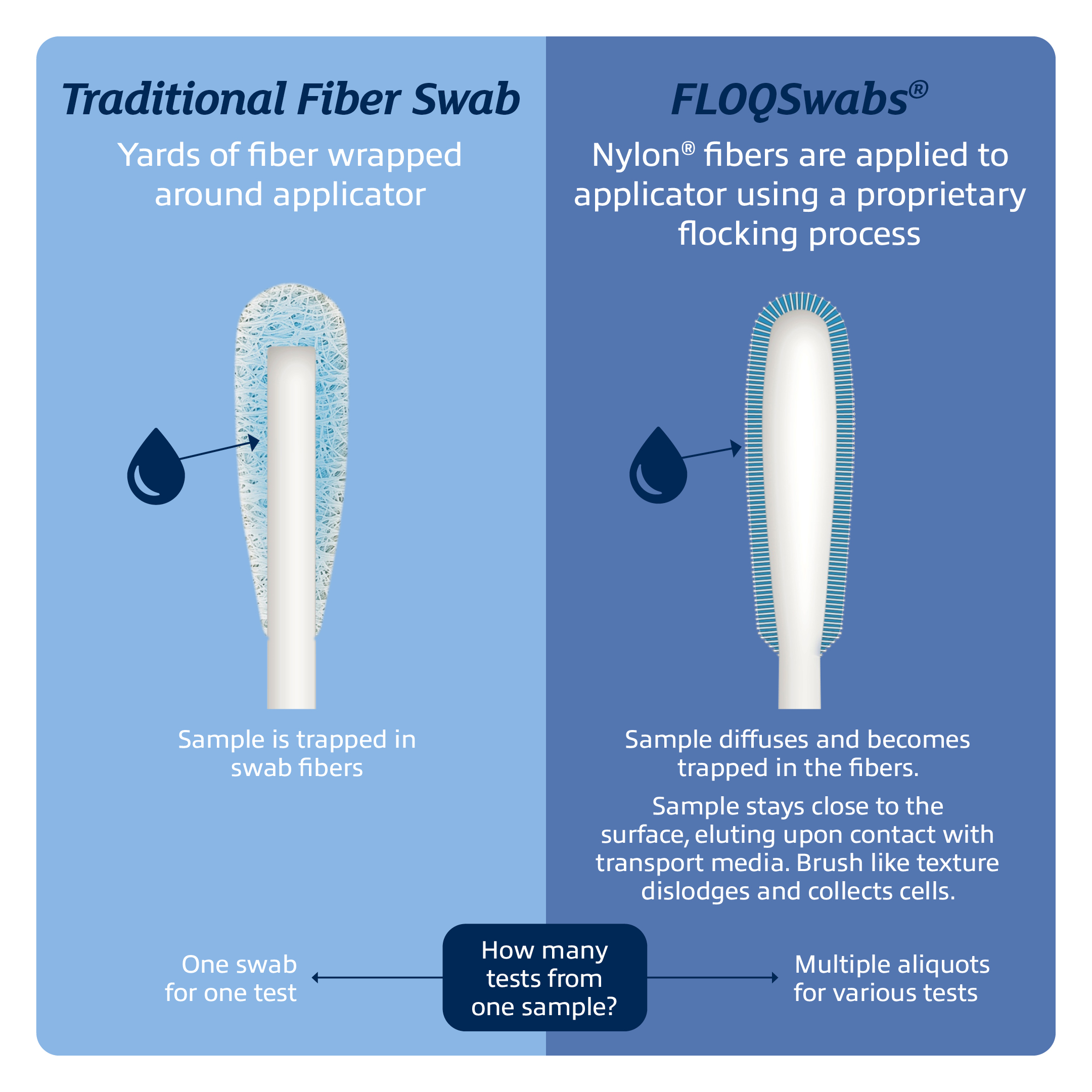
This unique and innovative design pairs a perpendicularly applied nylon fiber tip with a non-absorbent substrate, maximizing the amount of specimen available for testing. In liquid-based systems such as Copan's ESwab®, which combines a flocked swab with 1 mL Liquid Amies, this enables multiple tests, including culture, Gram stain, and molecular testing, from the same specimen without sacrificing performance.2,4
Clinical performance begins with how many target cells are collected in a specimen. In a controlled study of volunteers and symptomatic patients, flocked nasopharyngeal swabs collected significantly more respiratory epithelial cells than rayon swabs. In healthy volunteers, the geometric means were approximately 58.6 versus 23.9 cells per high-power field, supporting improved downstream detection when pathogens reside in or on host cells.1
58.6 vs. 23.9
Respiratory epithelial cells per high-power field with flocked versus rayon swabs in healthy volunteers.1
Beyond cell yield, transport systems must preserve viable organisms for culture and accurately reflect organism burden for molecular testing. In a comparative evaluation against two Amies gel swab systems, ESwab® met CLSI M40 criteria and recovered an equal number or more isolates. It performed equivalently to BD CultureSwab MaxV and recovered more isolates than Remel BactiSwab in specific comparisons.2 These findings align with broader literature showing that efficient release from flocked tips enhances what reaches the assay.7-8
Patient-friendly collection, robust performance: In pediatric outpatients, nasopharyngeal flocked swabs improved viral detection compared with nasal washes by real-time PCR under the evaluated study conditions.7
Fastidious anaerobes are notoriously sensitive to collection and transport conditions. In a Journal of Clinical Microbiology study of 20 fastidious anaerobic species held at room temperature and 4 °C for up to 48 hours, ESwab® and an anaerobic agar transport system maintained comparable viability overall, meeting clinical transport needs even across extended transit times.3
20 species, up to 48 hours
Fastidious anaerobic bacteria were evaluated at room and refrigerated temperatures.3
Explore the full Tyrrell study →
For direct microscopy, material that is evenly eluted and aliquoted improves smear quality. In a head-to-head study of 80 patients and 240 smears, Gram smears prepared from ESwab® specimens showed easier identification of human cells and a greater number of microorganisms than smears from a traditional Amies gel swab system. Notably, smears prepared at 24–72 hours remained equivalent to those prepared within 2 hours, a useful finding when immediate processing is not possible.4
Explore the full Fontana study →
When directly compared with a legacy semi-solid gel transport system, the Venturi Transystem, flocked-swab liquid transport demonstrated higher quantitative survival for Escherichia coli, Streptococcus agalactiae, and Candida albicans at time zero and after refrigerated holding, indicating that more viable organisms reached the laboratory bench.5
In clinical MRSA screening, ESwab® recovered at least 3.6-fold more viable methicillin-resistant Staphylococcus aureus than the Venturi swab in quantitative comparisons. The two swabs performed equally in qualitative positive and negative results.6
Nys and colleagues evaluated E. coli, S. agalactiae, and C. albicans in ESwab® and the Venturi system.
Open the Nys publication →Smismans and colleagues reported at least 3.6-fold higher viable MRSA recovery with ESwab® in the evaluated conditions.
Open the Smismans publication →Efficient specimen capture and release help make more of the collected material available to the laboratory.
Across diverse use cases, including respiratory specimens, routine bacteriology, Gram stains, and fastidious anaerobes, the flocked-swab design behind FLOQSwabs® consistently improves what matters most: the quality and quantity of target material available to the assay. The results are stronger pathogen recovery, clearer microscopy, and transport stability for both culture and molecular workflows.
For laboratories seeking practical, evidence-based ways to boost diagnostic sensitivity and standardize pre-analytics, upgrading specimen collection using flocked swabs is a powerful place to start.
Product
Review collection configurations, design features, tip sizes, breakpoints, and current product information from Copan.
Visit the product page →Connect
Connect with Copan to explore how FLOQSwabs® and liquid-based microbiology solutions can fit your laboratory.
Contact Copan →Flocked swabs are brush-like, open-fiber collection devices without an internal absorbent core. The design promotes rapid specimen uptake and near-complete elution into liquid, helping make collected material available for downstream testing.
FLOQSwabs® pair a perpendicularly applied nylon fiber tip with a non-absorbent substrate. Collected cells and microorganisms remain close to the surface, supporting release when the swab enters a validated liquid medium.
In a controlled comparison, flocked nasopharyngeal swabs collected significantly more respiratory epithelial cells than rayon swabs. In healthy volunteers, the reported geometric means were approximately 58.6 versus 23.9 cells per high-power field.1
In liquid-based systems such as ESwab®, a flocked swab is combined with 1 mL Liquid Amies. This liquid format can support multiple validated workflows, including culture, Gram stain, and molecular testing, from the same collected specimen.2,4
No. Study findings are specific to the specimen types, collection methods, organisms, comparators, transport conditions, and assays evaluated. Laboratories should always follow the applicable product instructions for use, assay package insert, and validated internal procedures.
References supporting this research roundup are listed below. Expand each item for citation details, supporting context, and source links.
Daley P, Castriciano S, Chernesky M, Smieja M. Comparison of flocked and rayon swabs for collection of respiratory epithelial cells from uninfected volunteers and symptomatic patients. J Clin Microbiol. 2006;44(6):2265-2267. doi:10.1128/JCM.02055-05.
Compared flocked and rayon swabs and found significantly higher respiratory epithelial-cell recovery with flocked swabs.
Van Horn KG, Audette CD, Sebeck D, Tucker KA. Comparison of the Copan ESwab system with two Amies agar swab transport systems for maintenance of microorganism viability. J Clin Microbiol. 2008;46(5):1655-1658. doi:10.1128/JCM.02047-07.
Demonstrated that ESwab® met CLSI transport criteria and maintained microorganism viability comparably to, or better than, the evaluated Amies gel systems.
Tyrrell KL, Citron DM, Leoncio ES, Goldstein EJC. Comparison of the Copan ESwab system with an agar swab transport system for maintenance of fastidious anaerobic bacterium viability. J Clin Microbiol. 2016;54(5):1364-1367. doi:10.1128/JCM.03246-15.
Evaluated 20 fastidious anaerobic species through 48 hours and found comparable overall viability between ESwab® and the anaerobic agar transport comparator.
Fontana C, Favaro M, Limongi D, Pivonkova J, Favalli C. Comparison of the ESwab collection and transportation system to an Amies gel transystem for Gram stain of clinical specimens. BMC Res Notes. 2009;2:244. doi:10.1186/1756-0500-2-244.
Compared 240 Gram-stain smears from 80 patients and reported easier identification of human cells and more visible microorganisms with ESwab® specimens.
Nys S, Vijgen S, Magerman K, Cartuyvels R. Comparison of Copan ESwab with the Copan Venturi Transystem for the quantitative survival of Escherichia coli, Streptococcus agalactiae and Candida albicans. Eur J Clin Microbiol Infect Dis. 2010;29(4):453-456. doi:10.1007/s10096-010-0883-5.
Reported higher quantitative recovery with ESwab® than with the Venturi system for the three evaluated organisms under the study conditions.
Smismans A, Verhaegen J, Schuermans A, Frans J. Evaluation of the Copan ESwab transport system for the detection of methicillin-resistant Staphylococcus aureus: a laboratory and clinical study. Diagn Microbiol Infect Dis. 2009;65(2):108-111. doi:10.1016/j.diagmicrobio.2009.06.015.
Reported at least 3.6-fold higher viable MRSA recovery with ESwab® than with the Venturi swab in quantitative comparisons, while qualitative positive and negative results were equal.
Munywoki PK, Hamid F, Mutunga M, et al. Improved detection of respiratory viruses in pediatric outpatients with acute respiratory illness by real-time PCR using nasopharyngeal flocked swabs. J Clin Microbiol. 2011;49(9):3365-3367. doi:10.1128/JCM.02231-10.
Showed improved respiratory-virus detection with nasopharyngeal flocked swabs compared with nasal washes in the evaluated pediatric PCR workflow.
Chernesky M, Castriciano S, Jang D, Smieja M. Use of flocked swabs and a universal transport medium to enhance molecular detection of Chlamydia trachomatis and Neisseria gonorrhoeae. J Clin Microbiol. 2006;44(3):1084-1086. doi:10.1128/JCM.44.3.1084-1086.2006.
Demonstrated that flocked swabs paired with universal transport medium enhanced detection of low analyte levels in selected molecular assays.
Silbert S, Kubasek C, Uy D, Widen R. Comparison of ESwab with traditional swabs for detection of methicillin-resistant Staphylococcus aureus using two different walk-away commercial real-time PCR methods. J Clin Microbiol. 2014;52(7):2641-2643. doi:10.1128/JCM.00315-14.
Provides additional evidence on ESwab® performance in two commercial real-time PCR workflows for MRSA detection.
Educational use: This article summarizes selected peer-reviewed studies. Study results are specific to the methods, organisms, specimen types, comparators, and conditions evaluated. Some publications may discuss uses or workflows that are not included in current product labeling.
Always refer to the applicable product instructions for use and diagnostic assay package insert. Product availability and regulatory status may vary by market. All third-party trademarks are the property of their respective owners.